
Betariqبيت طارق

JoMedica Exchange

Every care provider, one record for the patient, with their consent

A health information exchange on FHIR R4 that connects every care provider to the patient's record, with consent and an audit of every access.

Main features

The Exchange at work
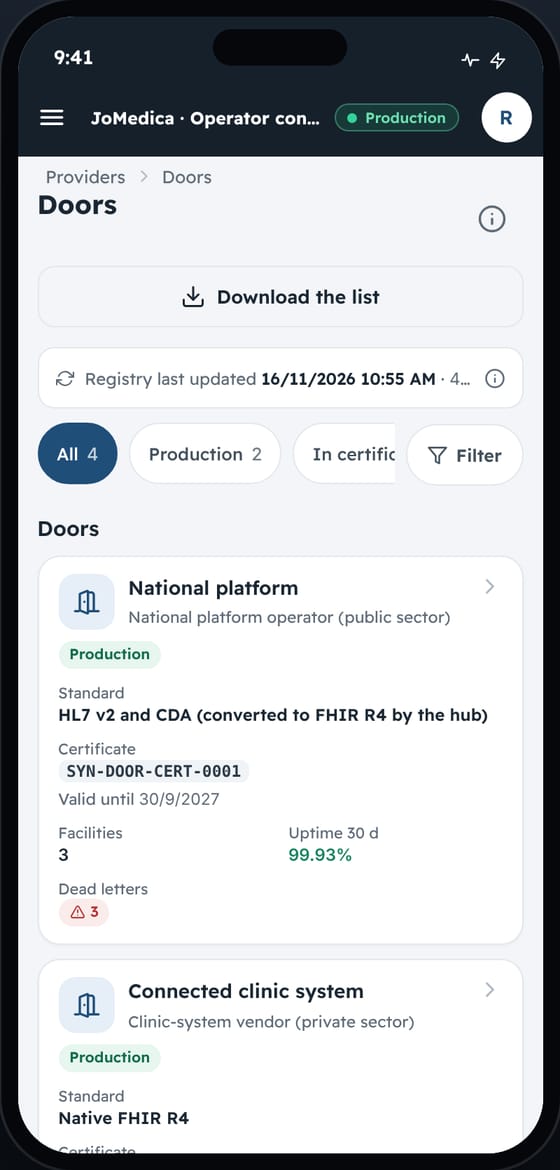
  • Connected systems
    Connected systemsThe operator sees every connected system, its standard and its state.Demonstration data: synthetic patients
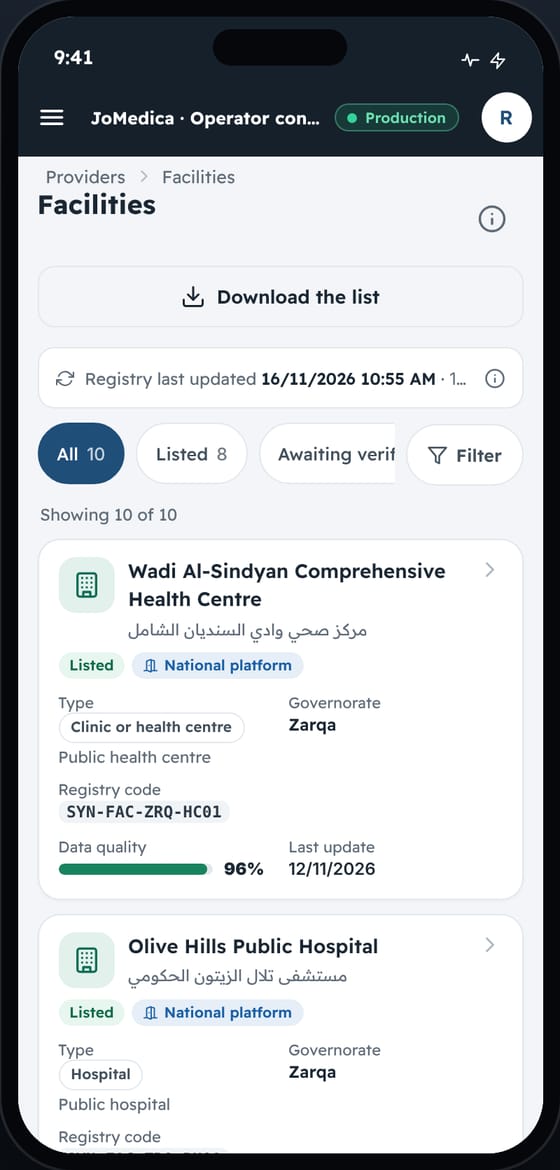
  • Facility registry
    Facility registryEvery registered facility, its type, its location and its data quality.Demonstration data: synthetic patients
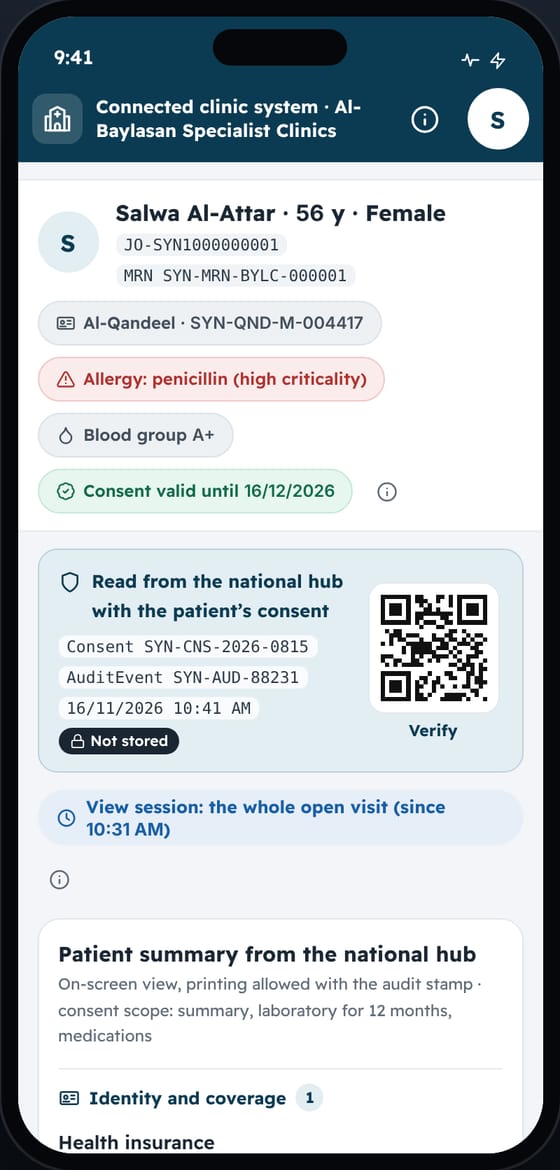
  • Read with consent
    Read with consentA clinic reads the patient's record only with consent, and the read is logged.Demonstration data: synthetic patients
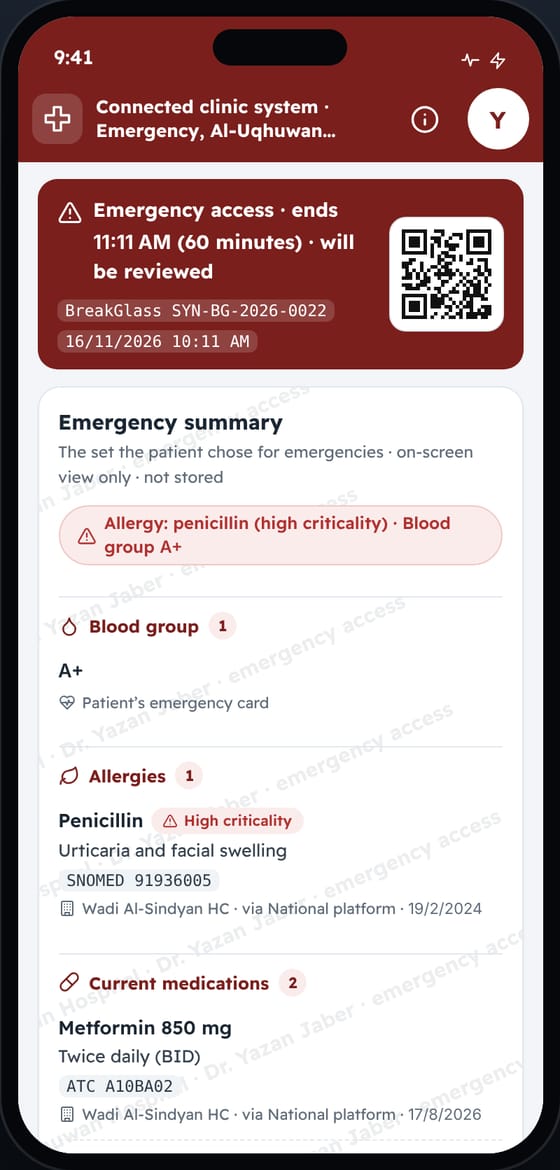
  • Emergency access
    Emergency accessBreak-glass access with a reason and a time limit, shown to the patient.Demonstration data: synthetic patients
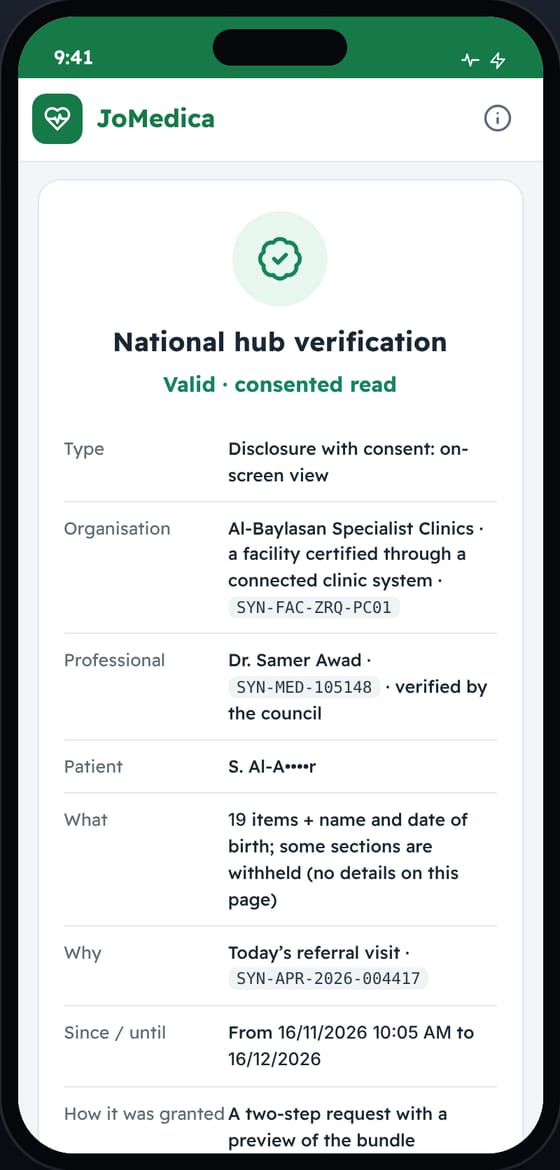
  • Public verification
    Public verificationAny document can be checked by its code: who read what, and under which consent.Demonstration data: synthetic patients
  • One decision point for consentTwo-step consent and trusted providers, decided in one place for every system.
  • An audit log that cannot be erasedEvery access and every change is kept in an append-only, chained log.
  • FHIR R4 and the patient summaryEvery system writes in one standard, and the record is built as an International Patient Summary (IPS).

An exchange built on FHIR R4 that connects hospitals, clinics, laboratories, pharmacies and insurers to the patient's unified record: one decision point for consent, an audit trail for every access, identity and registries, and transformation engines for any existing system.

Architecture

One platform, four layers of connection

It works for a hospital group, a laboratory network or a whole national system.

01Organisations writeRegistered platforms write to the unified record through transformation engines, in one direction.
02Government exchangesSigned events: births, deaths, certificates and claims, each under its own law and agreements.
03Research readsAggregate statistics, approved connections and in-depth analysis in a secure environment.
04People accessThe patient, their family and the treating clinician, with consent, and they see every access.

How organisations connect

Four routes, one standard

Every visit arrives as a signed document, at a level the reader can see: a PDF, then structured sections, then fully coded entries.

Directly on the platformThe organisation works in JoClinics, and writing is automatic.
Your own systemYou keep your system, and it connects through HL7 v2 or FHIR and a transformation engine.
The light portalFor small and remote clinics: in the browser, with nothing to install and no servers.
The paper bridgeFor those with no system: a printed summary with a time-limited QR code.

Components

Eight components, each with a clear purpose

Health identityOne lifetime health number, matching, temporary identities and reviewed merges.
Unified health recordThe International Patient Summary (IPS), built from everything the platforms write.
Consent and governanceOne decision point, two-step consent and trusted providers.
RegistriesPeople, facilities, health workers, products and terminology.
Statistics and researchDe-identified reports by default, FHIR MeasureReport and DHIS2.
Audit and securityAn append-only, chained log that cannot be erased, and documented emergency access.
Digital certificatesSick leave, fitness and vaccination, signed and verifiable by code.
Developer portalDocumented APIs and a sandbox with synthetic data.

Standards

One language for health data

Content, terminology, transport and security: four kinds of standard that every connected system writes in, and that every report comes from.

  • HL7 FHIR R4
  • HL7 v2
  • IPS
  • SMART on FHIR
  • OpenID Connect
  • OAuth 2.0
  • FHIR Bulk Data
  • LOINC
  • ICD-10
  • ICD-11
  • SNOMED CT (where licensed)
  • ATC
  • UCUM
  • DHIS2 ADX
  • IHE

For developers

Modern APIs and a sandbox

A FHIR R4 REST API with OAuth 2.0 and OpenID Connect authentication, SMART on FHIR app launch, Bulk Data export, the official HL7 validator in the build pipeline, and a sandbox with synthetic data.

Questions from managers and engineers

Does the platform replace our systems?
No. It connects and extends them; every provider keeps its own system and record.
Who decides who can see the data?
The patient, through their consent, under rules set by the operating authority and data protection law.
Where is it hosted?
In the cloud or in-country, on your infrastructure or on approved infrastructure.
Does it support legacy systems?
Yes, through HL7 v2 and transformation engines, the light portal and the paper bridge.

See the platform connect your systems

A demo on synthetic data, and a review of your systems' interfaces. Prices on request.

Book a demo